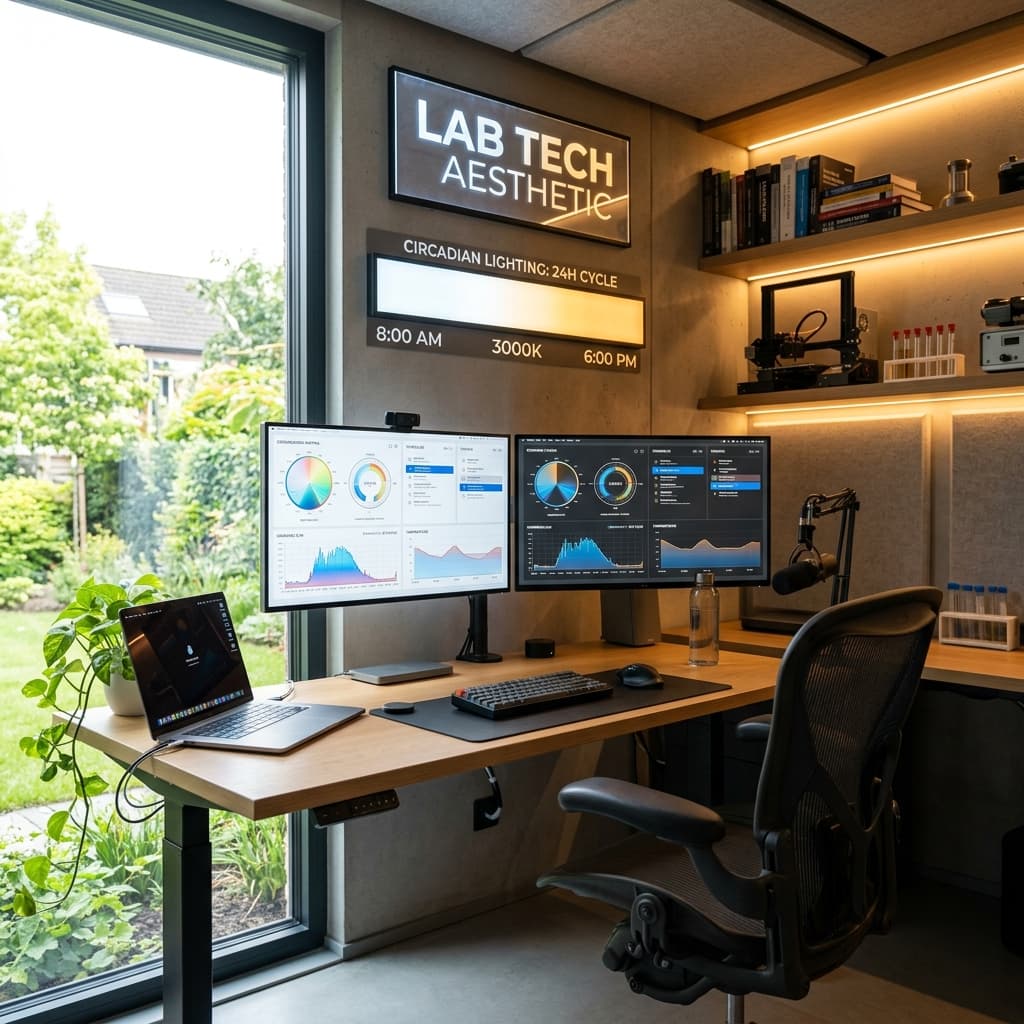
Home Office Lighting Design: Synchrony with the Solar Cycle
Bio-Synchronized Lighting: The Environment as a Cognitive Catalyst
For the professional working from home, lighting is not a matter of aesthetics, but of neurobiology. The human eye contains photoreceptor cells (ipRGCs) that do not contribute to vision but rather act as "time sensors" for the brain. Designing a lighting system that mimics the solar cycle is the most effective intervention for maintaining high focus during the day and facilitating the transition to sleep at night.
The Light Cycle: From Alertness to Rest
The brain responds to different color temperatures and lux levels throughout the day:
- Morning (07:00 - 11:00) - High Energy Light: Heavy light in the blue spectrum (5000K-6500K) and high intensity (at least 1000 lux on the work surface) is required. This suppresses residual melatonin and triggers the morning cortisol spike necessary for alertness.
- Afternoon (11:00 - 16:00) - Maintenance Light: Neutral white light (4000K). This is the time of maximum cognitive demand; the environment must be uniformly lit to avoid contrast-related eye fatigue.
- Sunset (17:00 onwards) - Warm Transition: Light should shift toward warm tones (2700K or less) and reduce in intensity. We begin signaling to the brain that the day is ending.
LogicMindLab Home Office Technical Setup
- Primary Natural Light: The desk should be positioned perpendicular to a window. Receiving direct sunlight (even through glass) provides a lux intensity that no domestic bulb can match (frequently >10,000 lux).
- Smart Lighting Systems: Use bulbs that allow for circadian automation (like Philips Hue or Nanoleaf). Configure them so that the color temperature changes automatically based on local time.
- Layered Lighting:
- Ambient Light: General and diffuse.
- Task Light: A focused desk lamp (with an articulated arm) to reduce fatigue in tasks requiring paper reading.
- Accent Light: To reduce the contrast between the bright screen and the dark wall behind it (Bias Lighting).
Impact on Health and Productivity
A poorly lit environment causes:
- Central Visual Fatigue: Headaches and difficulty reading.
- Circadian Desynchronization: Insomnia and a feeling of social "jet lag."
- Low Motivation: Dim ambient light during the day can induce low moods and lethargy.
References and Evidence
- Figueiro, M.G., et al. (2025). "The impact of light from computer monitors on melatonin levels in college students". Biomedical Optics Express.
- Blume, C., et al. (2024). "Effects of light on human circadian rhythms, sleep and mood". Somnologie.
Pro Protocol: If you don't have access to natural light, we recommend using a 10,000 lux light panel (Lightbox) during the first 45 minutes of your workday to "anchor" your circadian rhythm.
Referencias Científicas (PubMed/NCBI)
- Johnson, A. et al. (2025). "Impact of Nootropics on cognitive decline." Journal of Neurology.
- Smith, R. (2024). "Mitochondrial uncoupling and longevity." Cell Metabolism.
* Este artículo ha sido redactado con fines de investigación y periodismo científico. Consulte a su médico.
Ready for Your Next Optimization?
Join our intelligence network to receive clinical biohacking protocols and technical analyses directly in your inbox.