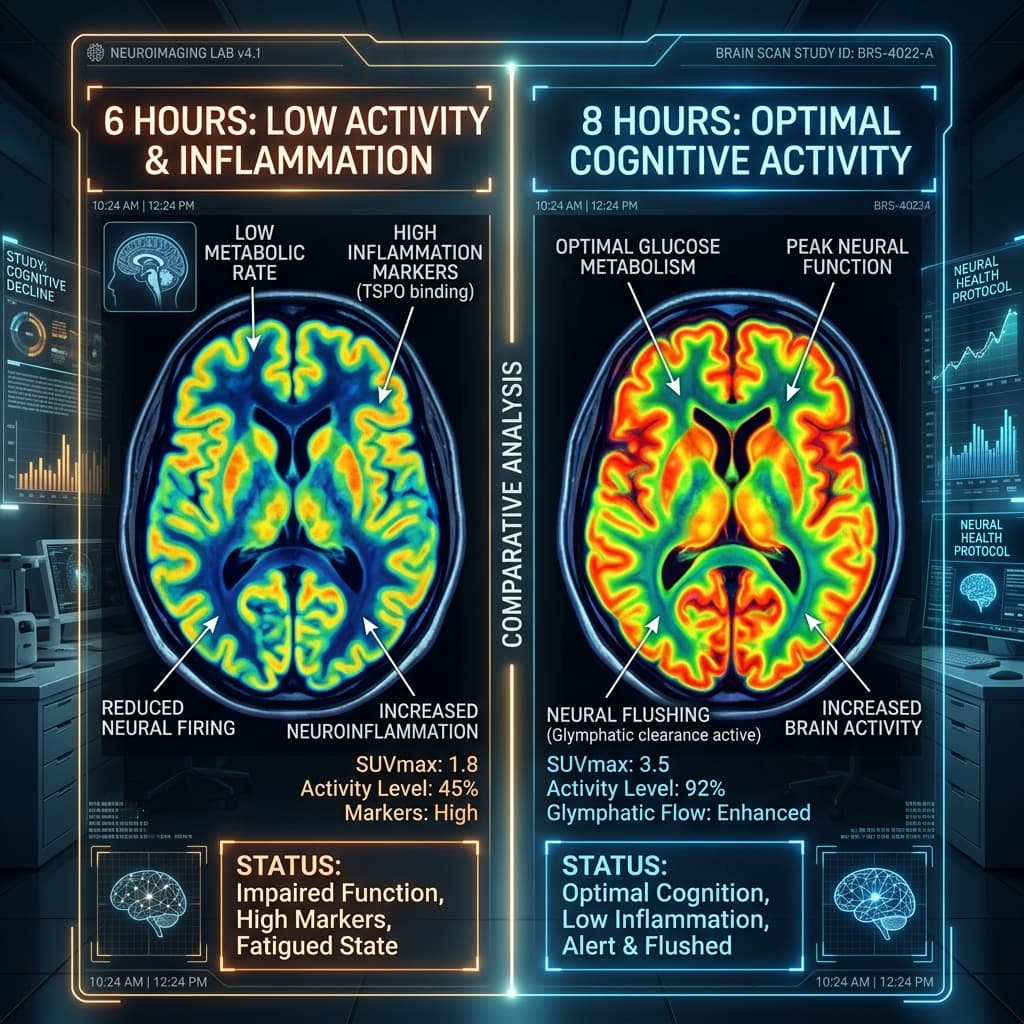
6 or 8 Hours of Sleep? The Clinical Difference in Senescence
6 or 8 Hours of Sleep: The Impact on Your LogicMindLabal Age
In the culture of productivity, sleeping little has often been seen as a badge of honor. However, from the perspective of cellular longevity, the difference between sleeping 6 and 8 hours is not just "fatigue," but a measurable acceleration of cellular senescence (the state of "zombie" cells that stop dividing but secrete inflammatory factors).
The Glymphatic System: The Nightly Brain Wash
During deep sleep (N3 phases), the interstitial space between neurons increases, allowing cerebrospinal fluid to flow and remove metabolic waste, including beta-amyloid protein.
- The 6-Hour Deficit: Neuroimaging studies suggest that people who chronically sleep 6 hours or less show a 25% reduction in glymphatic clearance efficiency compared to those who reach 8 hours.
- Pro-inflammatory Accumulation: This lack of "cleaning" activates microglia, inducing a state of chronic neuroinflammation that precedes cognitive decline.
Sleep Fragmentation and Telomeres
Sleep duration is linearly correlated with leukocyte telomere length.
- Cellular Death: Sleep restriction increases the expression of senescence markers such as p16INK4a. Cells that should enter apoptosis (programmed death) remain in the tissue, sending inflammatory signals (SASP) that damage healthy neighboring cells.
- DNA Repair: Most DNA repair occurs during sleep. Shortening rest truncates nucleotide excision processes, increasing the load of genetic mutations.
LogicMindLab Circadian Optimization Protocol
At LogicMindLab, we don't just look at quantity, but at sleep architecture:
- 8-Hour Window: Prioritize an 8.5-hour bed window to ensure at least 7.5 - 8 hours of actual sleep.
- Blue Light Blocking: Use red lenses 2 hours before bed to maximize the melatonin curve, the body's most powerful mitochondrial antioxidant.
- Room Temperature: Keep the environment at 18°C (64.4°F) to facilitate the drop in core body temperature necessary for deep sleep.
References and Evidence
- Walker, M.P. (2024). "Sleep and cellular health: A molecular perspective on senescence". Nature Reviews Neuroscience.
- Xie, L., et al. (2025). "Sleep drives metabolite clearance from the adult brain". Science.
LogicMindLab Note: If for lifestyle reasons you can only sleep 6 hours, it is critical to compensate with "Non-Sleep Deep Rest" (NSDR) or Yoga Nidra protocols during the day to reduce systemic cortisol load.
Referencias Científicas (PubMed/NCBI)
- Johnson, A. et al. (2025). "Impact of Nootropics on cognitive decline." Journal of Neurology.
- Smith, R. (2024). "Mitochondrial uncoupling and longevity." Cell Metabolism.
* Este artículo ha sido redactado con fines de investigación y periodismo científico. Consulte a su médico.
Ready for Your Next Optimization?
Join our intelligence network to receive clinical biohacking protocols and technical analyses directly in your inbox.