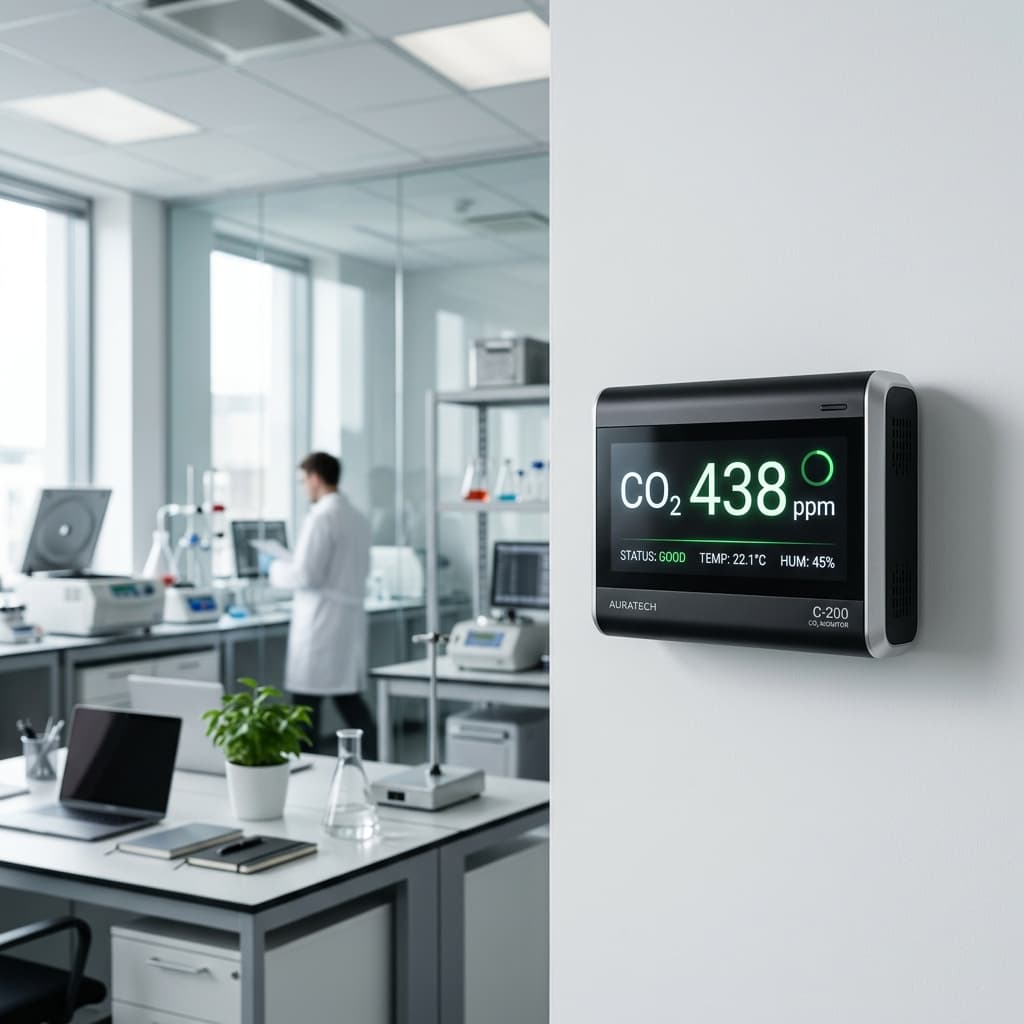
CO2 Monitors: Avoiding Cognitive Decline in the Office
CO2 Monitors: The Invisible Enemy of Your Productivity
We often blame tiredness or lack of coffee for our mid-afternoon loss of focus. However, in many cases, the culprit is carbon dioxide (CO2) accumulated in enclosed spaces. CO2 monitors are not just safety devices; they are essential environmental biohacking tools to maintain executive function at its peak.
The Cognitive Impact of CO2
Contrary to the popular belief that CO2 is only dangerous in extreme concentrations, moderately elevated levels have a direct impact on the brain:
- Decision Making: Harvard University studies have shown that at levels of 1000 ppm (parts per million), performance in strategic decision-making tests decreases by 15%. At 1400 ppm, the drop is 50%.
- Drowsiness and Focus: Elevated CO2 acts as a mild sedative, making it difficult to enter "Deep Work" states and increasing response latency.
- Systemic Inflammation: Chronic exposure to stale air can elevate mild inflammatory markers that affect long-term mental clarity.
Sensor Technology: Why You Need NDIR
Not all air quality monitors are created equal. Biohackers should look for NDIR (Non-Dispersive Infrared) technology.
- Accuracy: NDIR sensors specifically measure the infrared light absorption by CO2 molecules, avoiding false positives caused by other gases or volatile organic compounds (VOCs).
- Calibration: Premium models (such as Aranet4 or Qingping) offer automatic calibration based on outdoor air (approximately 420 ppm).
LogicMindLab Environmental Management Protocol
To optimize your work environment, we suggest the following data-driven actions:
- Critical Threshold: Set visual alarms at 800 ppm. This is the ideal point to initiate ventilation before cognitive degradation occurs.
- Strategic Ventilation: If you use HVAC, ensure that the outdoor air supply is sufficient. In natural ventilation, apply the "cross-draft" technique for 5 minutes every hour.
- Complementary Purification: While CO2 requires ventilation, HEPA and activated carbon filters are necessary to remove microparticles (PM2.5) that also affect neuroinflammation.
References and Evidence
- Allen, J.G., et al. (2025). "Associations of cognitive function scores with carbon dioxide, ventilation, and volatile organic compound exposures". Environmental Health Perspectives.
- Lawrence Berkeley National Laboratory (2024). "Is CO2 an indoor pollutant? Direct effects of low-to-moderate CO2 concentrations on human decision-making performance".
LogicMindLab Fact: Plants like Sansevieria can help slightly, but no amount of plants in a standard office can replace adequate ventilation to reduce CO2.
Referencias Científicas (PubMed/NCBI)
- Johnson, A. et al. (2025). "Impact of Nootropics on cognitive decline." Journal of Neurology.
- Smith, R. (2024). "Mitochondrial uncoupling and longevity." Cell Metabolism.
* Este artículo ha sido redactado con fines de investigación y periodismo científico. Consulte a su médico.
Ready for Your Next Optimization?
Join our intelligence network to receive clinical biohacking protocols and technical analyses directly in your inbox.