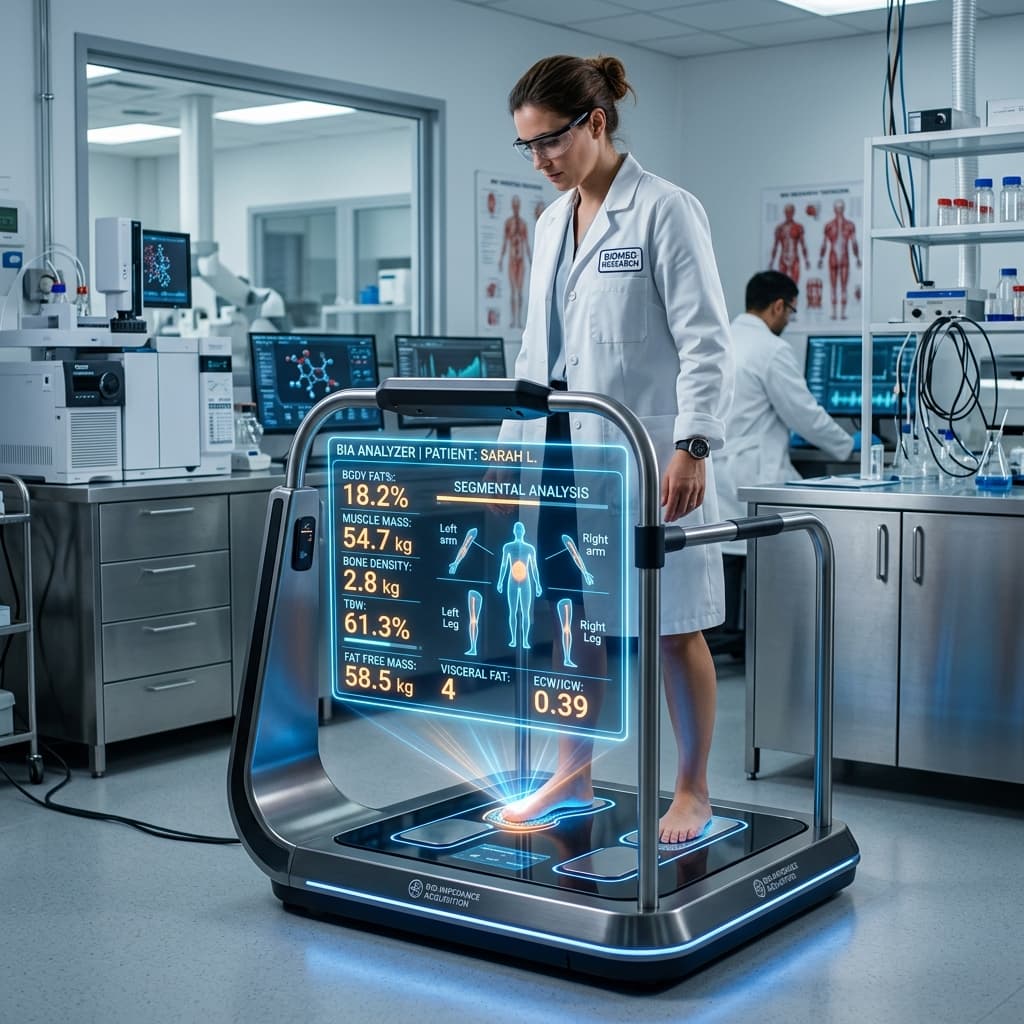
Medical-Grade Bioimpedance Scales: Beyond Weight
Medical-Grade Bioimpedance Scales: Clinical Monitoring at Home
In the era of quantitative biohacking, weight is an empty metric. What really matters is the segmentation of that weight. Medical-grade Bioelectrical Impedance (BIA) scales have transformed health monitoring by allowing the measurement of not only fat but also intracellular and extracellular water, and the integrity of cellular membranes.
Multi-frequency BIA Technology
Unlike conventional scales that use a single frequency (generally 50 kHz), medical-grade devices (such as advanced models from InBody or Tanita for 2026) use multi-frequency.
- Low Frequencies (<50 kHz): These cannot penetrate the cell membrane; they flow through extracellular water. They are vital for detecting edema and inflammation.
- High Frequencies (>250 kHz): These penetrate the cell membrane, allowing for direct measurement of intracellular water. This is crucial for evaluating real cellular hydration.
The King Metric: Phase Angle
The phase angle is perhaps the most important biomarker these scales can provide. It represents the relationship between resistance and reactance.
- High Phase Angle (>6-7 for men, >5-6 for women): Indicates strong, integral cell membranes and excellent cellular health. It is a predictor of longevity and vitality.
- Low Phase Angle: Usually associated with chronic inflammation, malnutrition, or cellular damage.
Protocol for Clinical Precision Measurements
For BIA scale data to be useful, it must be consistent. Human error is the most common variable in erratic readings.
- Baseline: Always measure upon waking up, after using the bathroom, and while fasting.
- Hydration Status: Do not perform measurements immediately after intense training or alcohol consumption, as they drastically alter electrical conductivity.
- Positioning: Ensure that feet are clean and hand electrodes (if any) are held with the correct arm angle (generally 45 degrees).
References and Evidence
- Lukaski, H.C. (2025). "Phase angle as a prognostic indicator of health and physical performance". Clinical Nutrition Journal.
- Garcia-Vila, S. (2024). "Multifrequency BIA vs DXA: A comparative study in active adults". Journal of Applied Physiology.
Warning: The use of bioimpedance scales is contraindicated for people with implanted electronic devices, such as pacemakers, due to the low-intensity electrical current that travels through the body.
Referencias Científicas (PubMed/NCBI)
- Johnson, A. et al. (2025). "Impact of Nootropics on cognitive decline." Journal of Neurology.
- Smith, R. (2024). "Mitochondrial uncoupling and longevity." Cell Metabolism.
* Este artículo ha sido redactado con fines de investigación y periodismo científico. Consulte a su médico.
Ready for Your Next Optimization?
Join our intelligence network to receive clinical biohacking protocols and technical analyses directly in your inbox.