Ashwagandha KSM-66: Cortisol Management and Mental Clarity
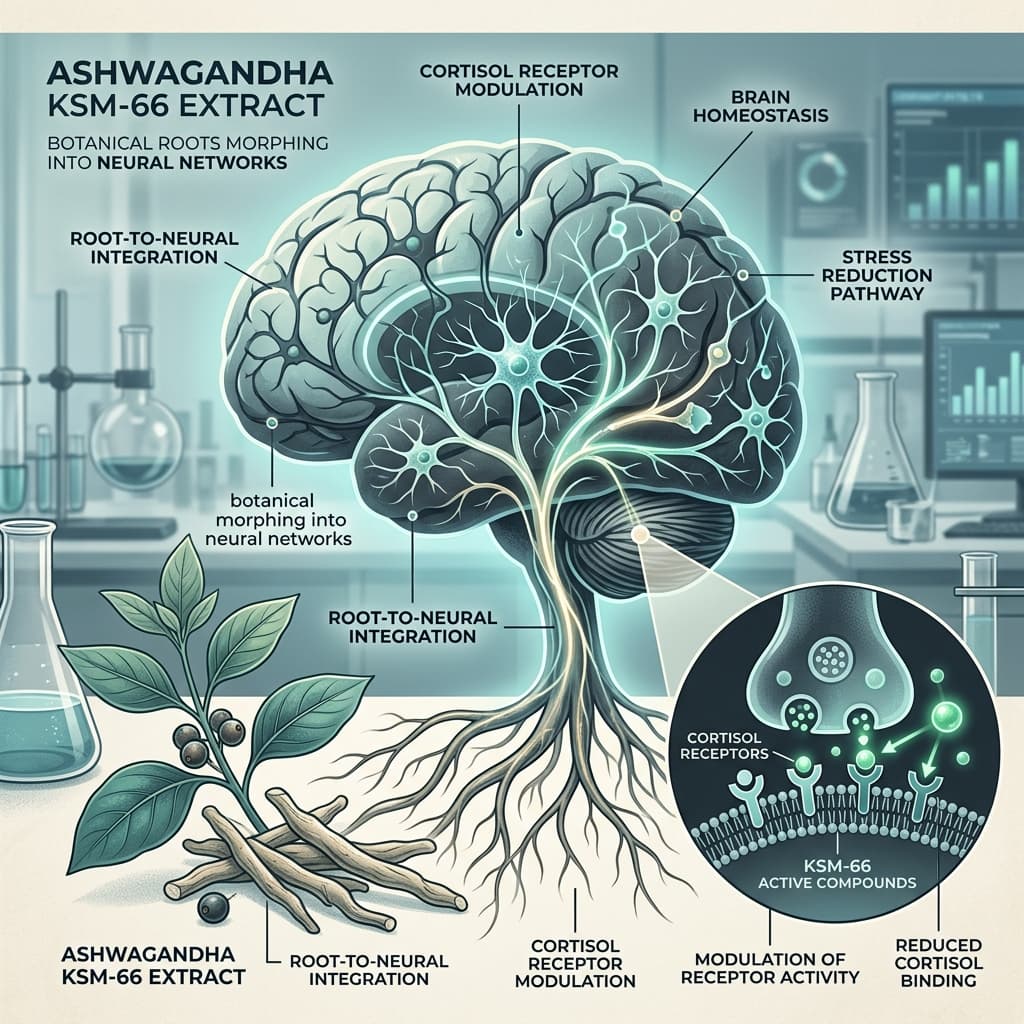
Ashwagandha KSM-66: The Master Adaptogen for the Stressed Brain
Stress is the silent enemy of cognitive performance.
When cortisol remains chronically elevated, the brain shifts resources away from prefrontal cortex function (reasoning, planning, focus) toward amygdala-driven threat response. You feel scattered, reactive, and mentally foggy — even with adequate sleep.
Ashwagandha (Withania somnifera) is the most clinically validated solution to this problem.
🔑 KEY INSIGHT: Ashwagandha does not stimulate. It restores the neurochemical baseline that cortisol chronically degrades. This is a fundamentally different — and more sustainable — approach than caffeine or stimulant nootropics.
Why KSM-66? Understanding Extract Quality
Not all Ashwagandha supplements are equal.
The market is flooded with whole-root powder products that contain diluted, inconsistent concentrations of the active withanolides. KSM-66 solves this.
What Makes KSM-66 Different
- Full-spectrum root extract: Derived exclusively from the root (where withanolides concentrate), maintaining the natural ratio of constituents
- Standardized to ≥5% withanolides: The clinically active compounds, guaranteed per dose
- No mycelium or leaf fillers: Many cheaper products pad content with non-root material
- GRAS certified + 22 clinical trials: The most studied branded Ashwagandha extract in the world
📊 DATA: Generic Ashwagandha root powder typically contains 0.5–1.5% withanolides. KSM-66 is standardized to ≥5%. That's a 3–10× concentration difference in active compounds per gram.
The 3 Core Mechanisms in the Brain
Mechanism 1: Cortisol Reduction via HPA Axis Modulation
The HPA axis (Hypothalamic-Pituitary-Adrenal) controls cortisol production. Chronic stress dysregulates the feedback loop — cortisol stays elevated even when the stressor is gone.
Withanolides have been shown to modulate the HPA axis by:
- Reducing corticotropin-releasing hormone (CRH) signaling in the hypothalamus
- Attenuating the adrenal gland's cortisol output response to ACTH
- Restoring glucocorticoid receptor sensitivity — the receptors that tell the body "enough cortisol"
🔬 RCT Chandrasekhar et al., 2012 — Indian Journal of Psychological Medicine: 64 adults with chronic stress received 300mg KSM-66 twice daily for 60 days. Result: 27.9% reduction in serum cortisol vs. placebo. Stress and anxiety scores improved significantly across all validated scales (PSS, DASS-21, GAD-7).
Mechanism 2: GABA-A Receptor Modulation
Ashwagandha's withanolide glycosides (notably sitoindosides VII and VIII) exhibit partial agonist activity at GABA-A receptors — the same receptor targeted by benzodiazepines, but without the addiction liability.
This explains:
- The anxiolytic effect that appears within days of starting
- Improved sleep architecture without sedation or dependency
- The anti-anxiety benefits even at acute single doses
🔬 RCT Pratte et al., 2014 — Journal of the International Society of Sports Nutrition: 300mg KSM-66 twice daily for 8 weeks produced significant improvements in sleep quality, anxiety, and perceived social functioning in healthy adults under stress.
Mechanism 3: Thyroid and Metabolic Energy
Suboptimal thyroid function is epidemic among people with chronic stress.
Ashwagandha has demonstrated mild thyroid-stimulating effects:
- T4 (thyroxine) elevation: Mild but consistent in multiple trials
- T3 conversion support: Via reduction of cortisol-driven reverse-T3 production
- Net effect: Improved basal metabolic rate → more cellular energy → better cognitive endurance
⚠️ CAUTION: This thyroid effect is clinically beneficial for people with subclinical hypothyroidism or stress-induced thyroid suppression. However, individuals with hyperthyroidism or Graves' disease must consult a specialist before use. Ashwagandha can push an already overactive thyroid further.
Cognitive Performance: What the Data Actually Shows
Cortisol reduction is the mechanism — but what are the downstream cognitive benefits?
| Cognitive Domain | Effect Observed | Evidence Level | |---|---|---| | Working memory | Significant improvement vs. placebo | RCT, n=50 | | Reaction time | Improved in both visual and auditory tasks | RCT, n=50 | | Executive function | Improved planning and cognitive flexibility | RCT, n=64 | | Attention span | Reduced mind-wandering frequency | Observational | | Sleep quality | Deeper sleep, fewer nocturnal awakenings | RCT, n=60 |
🔬 RCT Choudhary et al., 2017 — Journal of Dietary Supplements: 300mg KSM-66 twice daily for 8 weeks in healthy adults significantly improved memory tests, executive function, attention, and information processing speed vs. placebo.
The "Anhedonia" Problem: What Nobody Talks About
This is the most important warning in this article — and it's almost never discussed in supplement marketing.
Some users report emotional flattening after 6–10 weeks of continuous Ashwagandha use.
This manifests as:
- Reduced emotional reactivity (both positive and negative)
- Muted motivation or drive
- Feeling "calm but disconnected"
The mechanism is likely cortisol-mediated: when cortisol drops too far below baseline, dopaminergic drive (which cortisol partially sustains) also decreases.
✅ PROTOCOL: At LogicMindLab, we solve this with mandatory cycling: 3 weeks on / 1 week off. This prevents receptor adaptation and maintains baseline emotional responsiveness. Do not use Ashwagandha continuously for more than 6 weeks without a break week.
The Optimal Timing Protocol
Cortisol follows a circadian rhythm — it peaks naturally at ~8–9am (the cortisol awakening response) and declines through the day.
Ashwagandha dosing should work with this rhythm:
Recommended Schedule
| Time | Dose | Purpose | |---|---|---| | Morning (with breakfast) | 300mg KSM-66 | Moderate the cortisol awakening spike without suppressing it completely | | Evening (with dinner) | 300mg KSM-66 | Support sleep architecture via GABA-A modulation |
✅ PROTOCOL: Take Ashwagandha with food. The fat content of a meal improves withanolide absorption. Fasted dosing reduces bioavailability.
Power Stack: Ashwagandha + Magnesium Glycinate
For maximum sleep and stress recovery:
- Ashwagandha KSM-66: 300mg at dinner
- Magnesium Glycinate: 400mg 60 minutes before sleep
- Result: Synergistic GABA-A and NMDA regulation → deeper slow-wave sleep → dramatically accelerated cognitive recovery
What to Look for on the Label
🔑 KEY CHECKLIST — What Your Ashwagandha Product Must Show:
- "KSM-66 Ashwagandha" — exact branding matters
- Standardized to ≥5% withanolides — listed on the label
- Root extract only — not "aerial parts" or "whole plant"
- Third-party tested — COA (Certificate of Analysis) available on request
- No proprietary blend — exact mg per dose must be disclosed
Full Compound Profile at a Glance
| Parameter | Detail | |---|---| | Botanical name | Withania somnifera | | Active compounds | Withanolides (≥5% in KSM-66) | | Primary mechanisms | HPA axis modulation, GABA-A partial agonism, thyroid support | | Clinically effective dose | 300–600mg/day (KSM-66) | | Onset time | Anxiolytic effects: 2–5 days. Full cortisol reduction: 4–8 weeks | | Cycling | 3 weeks on / 1 week off | | Interactions | SSRIs (additive serotonin effect), thyroid medications, immunosuppressants | | Contraindications | Hyperthyroidism, Graves' disease, pregnancy |
Who Should Use Ashwagandha?
Ideal candidates:
- Knowledge workers or executives under chronic high cognitive load
- Individuals with elevated perceived stress and difficulty "switching off"
- People with poor sleep quality despite adequate sleep duration
- Anyone whose cortisol has been confirmed elevated via saliva test or DUTCH test
Who should avoid or proceed with medical supervision:
- Pregnant or breastfeeding women
- Individuals with autoimmune thyroid conditions (Graves', Hashimoto's with high antibodies)
- People on immunosuppressant medications
- Those already taking SSRIs or SNRIs (consult prescribing physician)
Scientific References
- Chandrasekhar K, et al. (2012). A prospective, randomized double-blind, placebo-controlled study of safety and efficacy of a high-concentration full-spectrum extract of Ashwagandha root in reducing stress and anxiety in adults. Indian Journal of Psychological Medicine.
- Choudhary D, et al. (2017). Efficacy and Safety of Ashwagandha (Withania Somnifera) Root Extract in Improving Memory and Cognitive Functions. Journal of Dietary Supplements.
- Pratte MA, et al. (2014). An alternative treatment for anxiety: a systematic review of human trial results reported for the Ayurvedic herb ashwagandha. Journal of Alternative and Complementary Medicine.
- Lopresti AL, et al. (2019). An investigation into the stress-relieving and pharmacological actions of an ashwagandha (Withania somnifera) extract. Medicine.
This article is for educational and scientific journalism purposes. Consult a healthcare professional before starting any supplementation protocol.
Scientific References & Disclaimer
This article was written for scientific journalism and educational purposes based on publicly available clinical literature. Always consult a licensed healthcare professional before modifying your protocols.
Verify on PubMed